
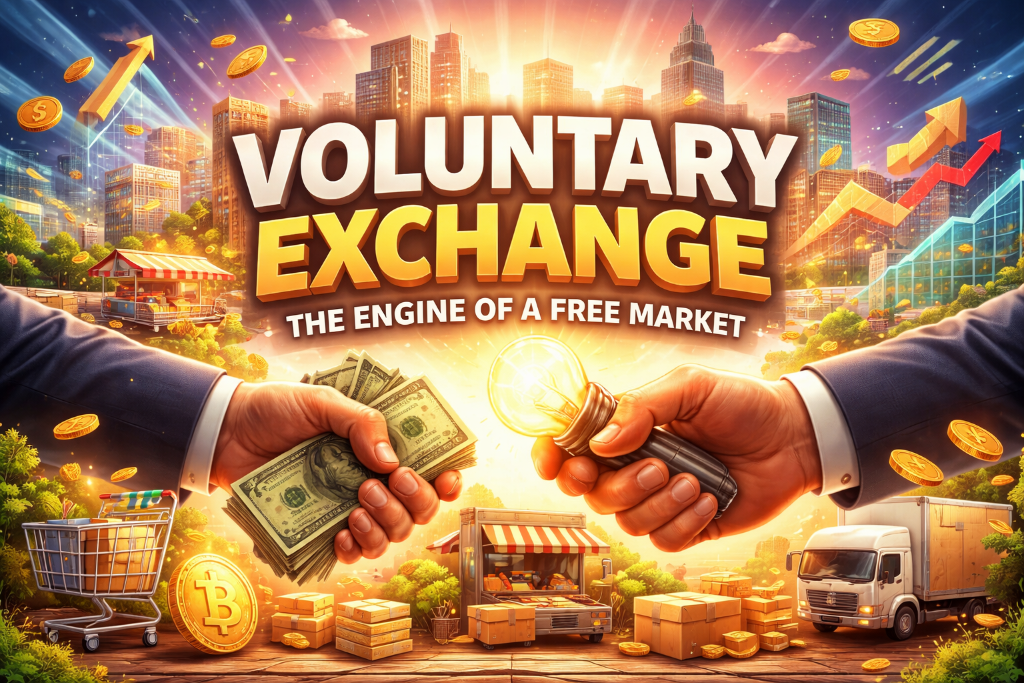
There is a quiet force that underpins every thriving economy, every successful business, and every mutually beneficial transaction in your daily life. It doesn’t require coercion. It doesn’t need enforcement. It operates on something far more powerful: consent.
That force is voluntary exchange.
At its core, voluntary exchange is simple—two parties agree to trade goods or services because both believe they will be better off afterward. No one is forced. No one is coerced. Yet, through millions—billions—of these interactions, entire economies rise, specialize, and evolve.
This is not just theory. This is the foundation of the free market.
What Voluntary Exchange Looks Like in a Free Market
In a truly free market, voluntary exchange is not the exception—it is the rule.
You walk into a barbershop. You pay for a haircut. The barber gains income; you gain a service you value more than the cash you gave up. That’s voluntary exchange.
You buy tools for your construction work. The manufacturer profits; you increase your productivity. Another voluntary exchange.
Zoom out, and this scales infinitely:
- Farmers trade crops for equipment
- Developers trade code for capital
- Investors trade capital for future returns
- Businesses trade value for customer loyalty
No central planner orchestrates this. No authority dictates terms at every level. Instead, prices, preferences, and competition coordinate human action in a decentralized way.
Voluntary exchange is not chaos—it’s order without central control.
What It Looks Like in Today’s Markets
Despite layers of regulation and intervention, voluntary exchange is still alive and well in modern markets—and in some places, it’s thriving more than ever.
1. The Gig Economy
Platforms like Uber and Fiverr are built entirely on voluntary exchange.
Drivers choose when to work. Customers choose when to ride. Freelancers set prices. Buyers decide what value is worth paying for.
No one is forced into these transactions—they happen because both sides see opportunity.
2. Online Marketplaces
On platforms like eBay or Shopify, individuals become entrepreneurs overnight.
A collector sells a rare item. A buyer values it more. Trade happens.
There’s no need for permission—just value creation and exchange.
3. Cryptocurrency Markets
The rise of Bitcoin represents voluntary exchange in its purest modern form.
No central bank. No gatekeeper. Just individuals choosing to store value, transact, and build parallel financial systems.
It is messy. It is volatile. But it is undeniably voluntary.
Why Voluntary Exchange Matters
Voluntary exchange is not just a mechanism—it’s a moral framework.
It implies:
- Mutual benefit over exploitation
- Consent over coercion
- Value creation over value extraction
- When exchange is voluntary, both parties win—or they walk away.
- That simple constraint forces:
- Better products
- Fairer pricing
- Continuous innovation
It disciplines producers and empowers consumers.
Where It Breaks Down
Let’s be honest—today’s markets are not perfectly free.
Barriers exist:
- Licensing requirements that restrict entry
- Regulations that favor incumbents
- Monetary policies that distort price signals
In many cases, exchanges are no longer purely voluntary—they are influenced, nudged, or outright constrained.
When choice is limited, voluntary exchange weakens.
When voluntary exchange weakens, inefficiency and frustration take its place.
Why It’s Still Necessary (and Unavoidable)
Here’s the truth: even in heavily regulated systems, voluntary exchange cannot be eliminated. Why? Because it reflects human nature.
People will always:
- Trade what they have for what they want
- Seek better outcomes
- Look for mutually beneficial opportunities
Even in restrictive environments, black markets emerge. Informal economies grow. Side hustles flourish. You can suppress voluntary exchange—but you cannot destroy it.
How We Could Respect It More
If voluntary exchange is the engine, then respect for it is the fuel.
That means:
- Lowering barriers to entry for entrepreneurs
- Reducing unnecessary regulation
- Allowing prices to reflect real supply and demand
- Encouraging competition over protectionism
It also means recognizing something deeper:
Every time you choose freely, negotiate fairly, and create value—you are participating in something profoundly powerful.
Voluntary Exchange: Quiet, Consistent, Relentless
Voluntary exchange doesn’t need a spotlight. It doesn’t demand recognition.
It simply works. Quietly. Consistently. Relentlessly. It feeds families, builds businesses, and connects strangers across the world.
Not through force—but through freedom.
In a world increasingly shaped by control, that might be the most radical idea of all.