
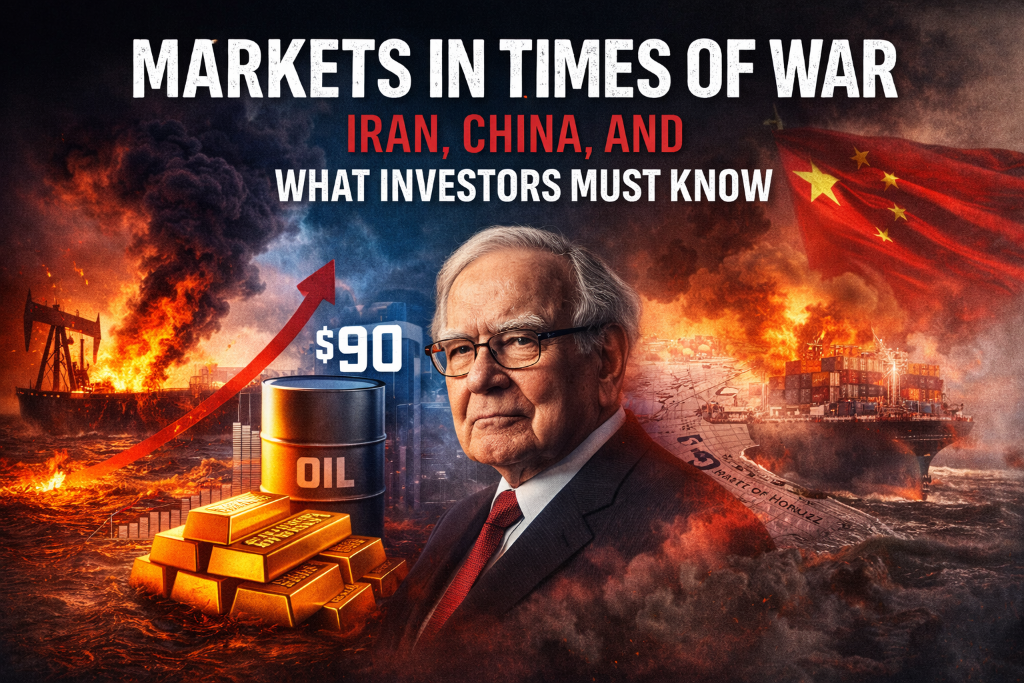
The Middle East is tense. The Iran conflict, Israel, and global powers are clashing. Oil spikes. Gold rises. Stocks wobble.
Markets don’t panic because they are emotional, they price uncertainty.
War Isn’t the Enemy
Markets hate uncertainty, not conflict itself. History shows patterns:
- Flight to Safety: Investors buy gold, treasuries, and high-quality debt.
- Short-term Equity Weakness: Stocks often drop in the days following escalation.
- Sector Divergence: Energy and defense sometimes outperform.
Example conflicts: Gulf War ’90, Iraq ’03, 9/11, Russia–Ukraine ’22. Short-term chaos → medium-term stabilization → long-term recovery (unless compounded by financial crises).
The Iran Factor
Iran matters because it sits near the Strait of Hormuz, a chokepoint for global oil.
Oil volatility surges → inflationary pressure rises → consumer spending dips → central banks adjust. Energy shocks ripple across markets. Geopolitics becomes a pricing mechanism for risk.
This isn’t speculation. It’s history repeating itself in probabilities.
The Silent War With China
Some observers quietly note that China has been testing energy supply vulnerabilities:
- There’s a strategic interest for the US in disrupting or influencing the Strait of Hormuz.
- Watching global reactions to Iran escalation
- Testing risk tolerance in energy markets
It’s a lose-lose scenario for China:
Escalate → global markets tighten → oil spikes → inflation rises → trade costs climb.
Don’t act → dependency on Middle Eastern energy remains high → geopolitical leverage stays in others’ hands.
Markets will quietly price in this ongoing “silent war” through energy futures, shipping insurance, and risk premiums, but the headlines rarely mention it.
Investors watching China’s moves should consider the indirect ripple effects on oil, supply chains, and equities globally.
Gold: The Crisis Hedge
Gold rises whenever geopolitical uncertainty grows.
War tension → gold up
Currency instability → gold up
Crisis insurance → gold up
It’s predictable. It’s consistent. Right now, gold is performing exactly as expected.
Buffett’s Cash Signal
Warren Buffett sits on $350B+ cash. This isn’t fear. It’s patience. Optionality. Discipline.
When a legendary value investor hoards liquidity, it signals caution in equities. Markets are priced for uncertainty; the smart move is to wait for opportunity, not chase headlines.
What Stocks Might Do
If the Iran conflict escalates:
- Oil and energy volatility will remain high
- Inflation pressures may rise
- Equities may wobble in the short term
If tensions stabilize:
- Risk premium compresses
- Equities recover
- Gold cools slightly
Markets price probabilities, not panic. Your role as an investor is to manage exposure, not react to every headline.
A Practical Framework
Diversify with Intent: Reduce concentrated risk. Consider hedges like gold or defensive sectors.
Hold Liquidity: Cash is optionality in volatile environments.
Manage Risk, Don’t Chase Noise: High volatility isn’t an entry signal without strategy.
Observe Sector Divergence: Defense, energy, and other crisis-resilient sectors often outperform.
Patience compounds. Discipline protects. Fear doesn’t pay.
Opportunities in Chaotic Times
War creates volatility. Volatility creates opportunity- for those prepared with cash, patience, and risk control.
The headlines will scream. Markets will whisper probabilities. Listen to the markets, not the media.