
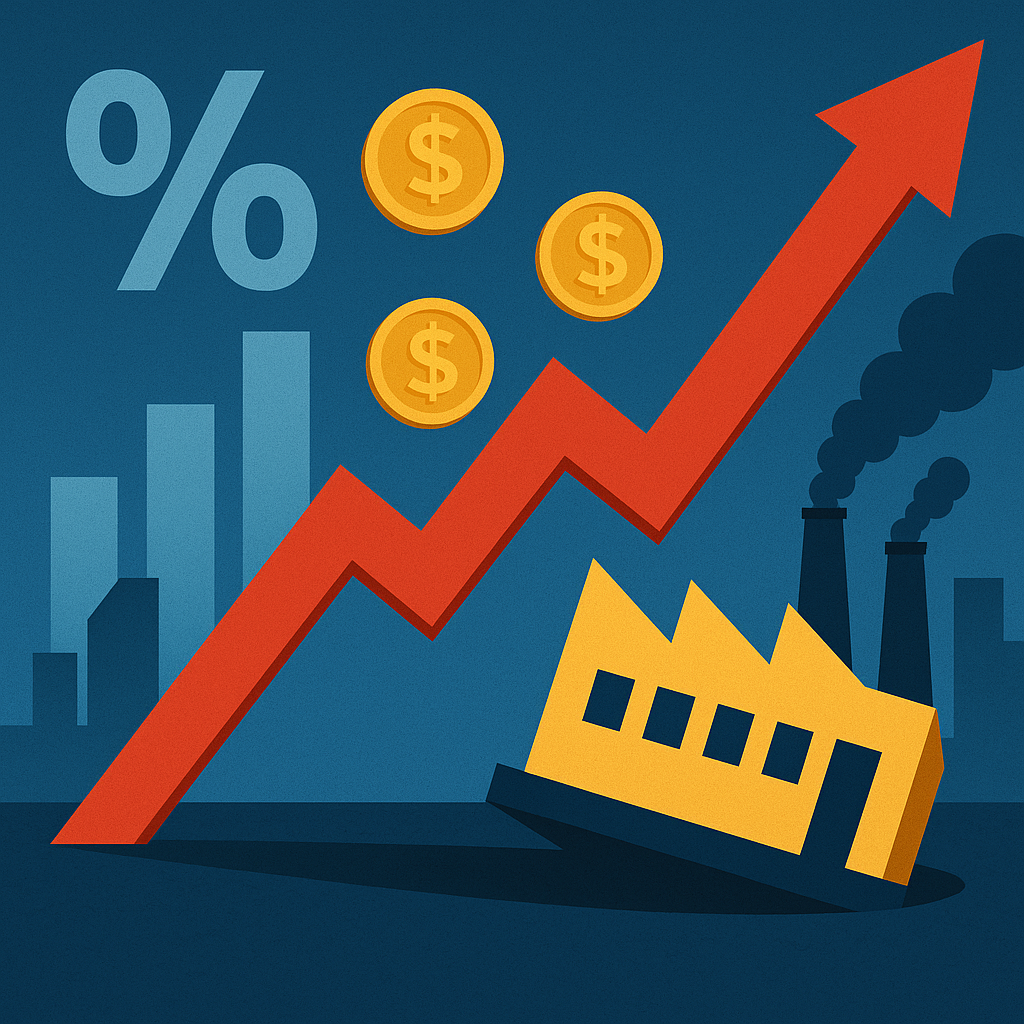
2025 was the year the world relearned the cost of capital. Interest rates in 2025 played a key role. After a decade of easy money, zero-rate illusions, and venture-fueled fantasies, the environment shifted hard: higher for longer became the rule, not the warning. Credit tightened. Margins compressed. And the market’s tolerance for firms that couldn’t carry their own weight evaporated.
This is where the zombie companies—those wandering corporate corpses barely kept “alive” by cheap credit—met their reckoning. When capital finally had a price, it became a sieve. The world saw, in real time, which firms created genuine economic value… and which survived only because debt used to be free.
The thesis is simple: high interest rates expose reality, and reality always wins.
I. Why Rates Stayed Elevated in 2025
Inflation never behaved. Central banks—burned by two years of false dawns and premature pivots—refused to repeat the same mistake. So they stayed tight.
Three forces kept 2025 interest rates elevated:
- Persistent inflationary pressure. Services inflation refused to fall. Energy was volatile. Wage growth remained stubborn.
- Global uncertainty. Geopolitical fragmentation and trade realignments created price instability—central banks hate instability.
- Policy caution. After the “transitory” debacle, credibility mattered more than market tantrums.
Interest rates are not just a policy lever; they’re a price signal—the market’s way of distinguishing viable ideas from unviable ones. When capital is cheap, everything looks fundable. When capital is properly priced, fragility becomes visible.
2025 was the year fragility had nowhere to hide.

II. What High Rates Did to Zombie Firms
For over a decade, ultralow rates incubated a generation of unproductive firms. These weren’t scrappy entrepreneurs—they were balance-sheet stowaways, businesses that survived only because debt was subsidized by monetary policy.
How zombies flourished earlier
- Interest expense was too low to force discipline.
- Investors chased growth narratives instead of cash flow.
- Debt refinancing was nearly free.
- Productivity didn’t matter—storytelling did.
By 2024–2025, the numbers were undeniable:
- The share of publicly traded firms unable to cover interest costs surged.
- Interest burdens jumped with every quarter-point hike.
- Entire sectors revealed they hadn’t been profitable for years—only funded.
Zombies crowd out real businesses by hogging labor, capital, and supply capacity. They suppress productivity. They misallocate resources. And they accumulate latent systemic risk.
High rates didn’t “cause” their collapse—they simply removed the artificial life support.
III. The Reallocation: Who Survived the Storm
When the tide of cheap money receded, the real operators—founders with discipline, firms with honest economics—rose to the surface.
What real businesses did differently
- Lean balance sheets. Lower leverage meant lower exposure to rate shock.
- Positive unit economics. Every product actually earned more than it cost to make. Revolutionary.
- Cash-flow discipline. Growth came from reinvested profits, not refinanced dreams.
- Responsive entrepreneurs. They treated interest as information, not an obstacle.
The new case studies of resilience
- Manufacturing firms that cut unnecessary debt and reinvested in automation rather than headcount bloat.
- SaaS companies that abandoned “growth at all costs” and returned to profitable customer segments.
- Bootstrapped founders who scaled slowly, preserved optionality, and now enjoy market share vacated by rate-dependent zombies.
The cleansing effect wasn’t destructive—it was regenerative.
Creative destruction finally remembered the “creative” part.
IV. What This Means for Capital Allocation in 2026
If you’re waiting for cheap capital to come back, stop. It’s not.
The 2026 landscape demands a different entrepreneurial mindset—one rooted in sober math, not venture-era fantasy.
What founders and investors must internalize
- Capital is expensive. Treat every dollar as if it costs something—because it does.
- Debt-funded growth is risky. High-rate volatility can erase margins overnight.
- Unit economics matter again. Gross margins, customer retention, and cash conversion cycles have replaced “user growth” as KPIs.
- Bootstrapping is no longer a stigma. It’s a competitive advantage.
A practical evaluation checklist
- Can revenue cover all costs plus debt service?
- Is your unit margin positive at a realistic scale?
- How sensitive is your model to rate changes?
- Does growth require debt—or does growth create cash?
- If credit markets froze tomorrow, would you survive six months?
The price of capital is information. Few founders listened when it whispered.
Everyone heard it when it shouted.
Back to Fundamentals
2025 repriced reality. High rates exposed the weak and rewarded the strong. The zombies that lived off monetary distortion finally collapsed, clearing space for productive businesses to thrive.
The lesson for entrepreneurs and investors entering 2026 is clear:
Stop mourning the era of free money. Start building in the real world.
Capital has a cost again—and that’s a good thing.