
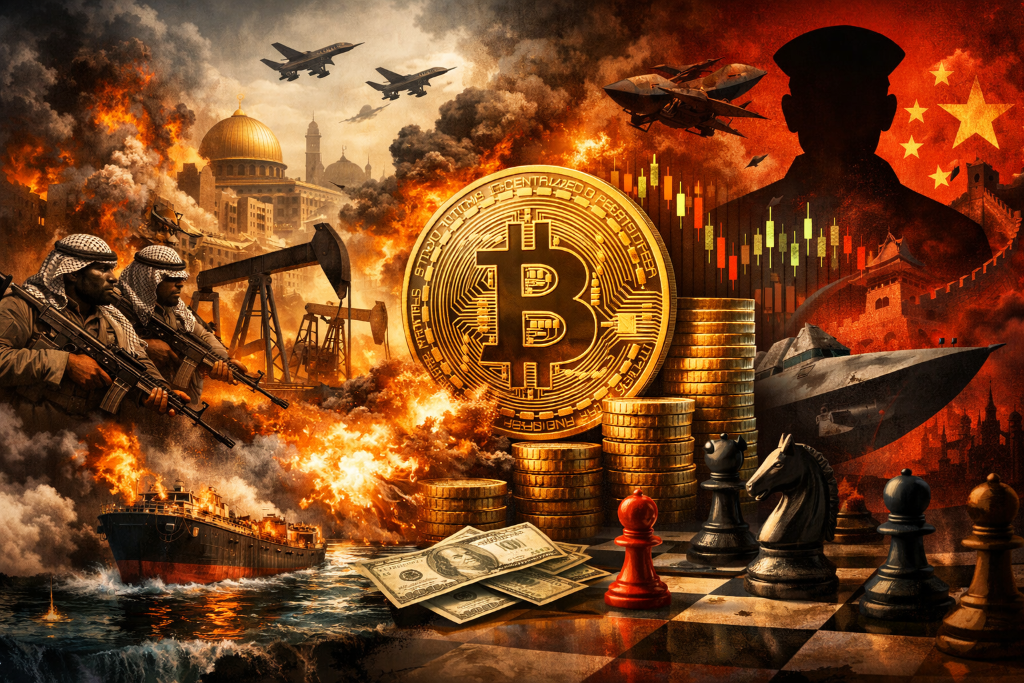
The Iran conflict made one thing clear: oil is still a chokepoint. The real geopolitical power moves happening right now- the ones reshaping markets, alliances, and long-term economic dominance- aren’t being fought over barrels. They’re being fought over Bitcoin and artificial intelligence. If you’re not watching that battlefield, you’re missing the bigger war.
This is the sequel nobody asked for but everyone needs to read.
The Chessboard Has Changed
In the last post, we broke down how conflict in the Middle East rattles oil markets, sends gold upward, and forces central banks to react. That framework still holds. Zoom out far enough and you’ll see that today’s most powerful nations aren’t just positioning military assets- they’re positioning compute power, financial infrastructure, and digital sovereignty.
The game isn’t just energy and weapons anymore. It’s code. It’s capital. It’s computation.
Three players are moving pieces on this board simultaneously: the United States, China, and a decentralized global market that answers to no flag. The tools they’re wielding -AI systems and Bitcoin- are more disruptive than any missile.
The AI Arms Race Is an Economic War in Disguise
When the U.S. restricted advanced semiconductor exports to China, it wasn’t just a trade dispute. It was an act of economic warfare dressed in policy language. The message was simple: whoever controls the most capable AI infrastructure controls the future of economic output.
Think about what AI actually is at scale. It’s productivity without payroll. It’s intelligence without borders. Nations that lead in AI development will compress decades of industrial advantage into years. They’ll optimize supply chains, model financial markets, run defense simulations, and generate scientific breakthroughs at speeds no human workforce can match.
This is why the geopolitical power moves happening around AI aren’t subtle. The U.S. CHIPS Act, export restrictions on Nvidia hardware, the race to recruit top AI researchers- these aren’t tech policy decisions. They’re strategic military-grade moves wrapped in Silicon Valley packaging.
China understands this. Their domestic push to develop competitive AI models, build sovereign chip manufacturing, and invest in AI-driven surveillance infrastructure is the other side of the same coin. Two superpowers, racing to own the cognitive infrastructure of the future.
For investors, this means one thing: the AI sector isn’t a hype cycle. It’s a strategic asset class backed by nation-state demand. That’s a different kind of floor.
China Is Getting Squeezed From Every Direction
Here’s what the mainstream narrative misses: China isn’t just losing the AI chip race. It’s getting compressed from multiple directions simultaneously- and that pressure is showing up in markets whether analysts name it or not.
Lock China out of advanced AI chips and you slow their ability to build the frontier models that drive next-generation economic output. That’s just one front. On the energy side, China remains one of the largest buyers of Middle Eastern oil, with heavy exposure to the Strait of Hormuz- the same chokepoint the Iran conflict puts at risk. Any disruption there doesn’t just hurt global markets. It hits China’s industrial base directly, at a moment when its economy is already under stress from a collapsing property sector, deflationary pressure, and a demographic cliff with no floor in sight.
Then add Bitcoin. China banned domestic mining in 2021, ceding the hashrate to the U.S., Kazakhstan, and others. That was a massive strategic error dressed up as an environmental policy. Now China sits outside the decentralized financial infrastructure it helped build- while its rivals use it as a sanctions-proof settlement layer.
Meanwhile, China’s digital yuan project- its answer to Bitcoin’s neutrality- requires trust in the Chinese Communist Party to hold its value. Outside of nations that have no choice, that trust simply isn’t there.
The result is a China being squeezed on chips, energy, and financial infrastructure at the same time. That’s not a trade dispute. That’s a multi-front siege. And markets are pricing it in slowly- which means by the time the headlines catch up, the opportunity will already be gone.
The Venezuela Move: America’s Oil Play Before the Conflict
Before a single strike was launched in the Iran theater, the U.S. was already repositioning its energy chess pieces. And Venezuela was the move nobody talked about loudly enough.
Venezuela sits on the world’s largest proven oil reserves. For years, the Maduro regime’s corruption and U.S. sanctions kept that oil locked up, leaving global markets tighter than they needed to be. Then Washington made a calculated pivot. In late 2022, the Biden administration quietly allowed Chevron to resume operations in Venezuela. By October 2023, it went further- suspending most energy sector sanctions entirely, flooding the zone with licenses for oil and gas transactions, and allowing European companies like Spain’s Repsol and Italy’s ENI back in.
The stated reason? Democratic progress and electoral agreements. The real reason? Energy optionality. The U.S. needed a lever it could pull if the Middle East deteriorated- and Venezuela was a proven reserve sitting untapped in America’s backyard.
When Maduro rigged the 2024 elections and the democratic cover evaporated, the U.S. snapped sanctions back. But the chess move was already made. The infrastructure had been tested. The relationships had been re-established. And when Maduro was removed from power in early January 2026, the Trump administration moved within days- issuing General License 46, opening Venezuelan oil to established U.S. entities, authorizing the lifting, refining, exporting, and marketing of Venezuelan crude.
Think about the timing. The Iran conflict is escalating. Middle Eastern oil supply is at risk. And the U.S. has just unlocked an alternate supply chain sitting 1,500 miles off the coast of Florida.
That is not a coincidence. That is a geopolitical power move executed years in advance- exactly the kind of long-game play that never makes the front page until it’s already over.
For investors paying attention: Venezuela’s energy sector is one of the most consequential emerging plays in the global oil market right now. It comes with enormous risk- the country has a history of nationalizing foreign assets without compensation, infrastructure is severely degraded, and the political situation remains fluid. But the strategic logic is airtight. High-reward potential lives right next to that risk, and long-horizon capital is already sniffing around.
Bitcoin: The Neutral Ground Nobody Controls
Here’s where the real chess gets interesting.
Gold was always the crisis hedge — we covered that. But Bitcoin is doing something gold never could. It’s becoming the hedge against the financial system itself.
When nations weaponize the dollar- freezing reserves, cutting countries off from SWIFT, applying economic sanctions- other nations notice. Russia’s frozen reserves after 2022 sent a signal heard in every finance ministry on earth: holding wealth in the Western financial system comes with counterparty risk at the sovereign level.
Bitcoin has no counterparty. It has no jurisdiction. It cannot be frozen. This isn’t ideology. It’s game theory. As economic warfare becomes a standard tool of geopolitical strategy, Bitcoin’s neutrality becomes a feature that governments are beginning to price in- not despite conflict, but because of it. The geopolitical power moves being made with Bitcoin aren’t just retail speculation. They’re sovereign-level positioning.
El Salvador was an early signal. U.S. executive discussion around a Bitcoin strategic reserve is another one. Nations aren’t buying Bitcoin because they believe in decentralization as a philosophy. They’re buying it because they don’t trust each other- and that’s a condition that isn’t going away.
For investors, Bitcoin’s role as a geopolitical hedge is becoming more credible by the year. Not as a speculative play. As a structural one.
Iran Was Mining Bitcoin for $1,300 a Coin — And That Changes Everything
Here is the detail that should stop you cold.
Iran legalized Bitcoin mining in 2019. Since then, the government has been mining Bitcoin at an estimated cost of roughly $1,300 per coin- and selling it at market price. At $68,000 per Bitcoin, that’s a margin that would make any hedge fund manager weep. Iran’s electricity subsidies are so extreme- industrial rates as low as $0.005 per kilowatt-hour, a fraction of the global average- that mining Bitcoin became one of the most profitable things a sanctioned nation-state could do.
And they did it at scale. Estimates put Iran’s share of global Bitcoin mining at 2–5% of total network hashrate. Blockchain analytics firm Chainalysis found Iran’s entire crypto ecosystem hit $7.78 billion in 2025, growing faster than the year before. That’s roughly the GDP of a small nation- generated through a parallel financial system that the U.S. Treasury cannot touch.
Here’s the mechanism: licensed miners in Iran mint Bitcoin using subsidized electricity, then are required to sell the BTC to Iran’s central bank. The central bank uses those coins to pay overseas counterparties for machinery, fuel, and consumer goods — all without a single dollar flowing through a U.S.-controlled bank
.
Bitcoin literally became Iran’s end-run around the dollar system. The IRGC — Iran’s Revolutionary Guard — was reportedly running its own large-scale mining operations, turning cheap domestic energy into borderless, sanction-proof liquidity.
This is the part that rewrites the entire narrative around the Iran conflict for crypto investors. It wasn’t just an oil story. It wasn’t just a Middle East stability story. It was a Bitcoin story. Targeting Iran’s power grid isn’t just about military infrastructure. It’s about dismantling a sovereign Bitcoin mining operation that has been quietly funding imports, bypassing sanctions, and proving — in real time — that decentralized money works exactly as designed.
Now conflict has put that grid at risk. Mining output from Iran is vulnerable to disruption. And every Bitcoin that doesn’t get mined in Iran is a block that gets picked up by miners in Texas, Kentucky, and Wyoming.
Follow the hashrate. It tells you who’s winning.
The Silent Economic War Still Rages
In the Iran conflict piece, we touched on China’s strategic exposure to the Strait of Hormuz- quietly watching how the West manages energy supply disruption, calibrating risk.
Add AI and Bitcoin to that picture and it becomes even more layered.
China is locked out of the most advanced Western AI chips. It holds massive U.S. Treasury debt as leverage- but that leverage cuts both ways. It’s expanding the digital yuan as a competing payment rail. It’s investing in African and Southeast Asian economies to build parallel financial infrastructure outside the dollar system.
Meanwhile, the U.S. is quietly tightening the digital noose: regulating crypto exchanges, pressuring allies on chip exports, building AI coalitions with democratic partners. The goal isn’t innovation. The goal is dominance.
Markets are pricing this in through every tech earnings report, every chip shortage, every regulatory announcement around crypto. The headlines say “tech sector.” The subtext is “empire.”
What Smart Money Is Watching
Buffett’s $350B+ cash position signals caution in traditional equities. But watch where the smart, long-horizon capital is moving.
Sovereign wealth funds are quietly accumulating AI infrastructure exposure. Pension funds are adding Bitcoin. Nation-states are hedging dollar risk. The geopolitical power moves being made right now with AI and Bitcoin aren’t speculative — they’re structural realignments happening in real time.
This doesn’t mean buy everything and pray. It means understand why these assets are moving and who is moving them. When governments are players in your market, the risk profile changes completely.
Defense is up because physical war is real. AI is up because cognitive war is real. Bitcoin is up because financial war is real.
That’s not three separate trends. That’s one thesis.
The Free Market Plays Its Own Game
Here’s the thing that no government fully understands yet: decentralized systems don’t respond to decrees.
AI research leaks across borders. Open-source models can’t be sanctioned. Bitcoin doesn’t care about executive orders — it just keeps producing blocks every ten minutes, in every jurisdiction, under every regime. Even as Iran’s grid gets targeted, the global Bitcoin network adjusts. Difficulty recalibrates. Other miners absorb the hashrate. The network heals itself.
That’s not a feature. That’s a design.
The free market has always been the most powerful geopolitical force. Nations think they’re playing chess with AI and Bitcoin as their pieces. But the board itself is owned by the market — and the market always wins.
For investors who understand this, the opportunity isn’t just financial. It’s historical. We’re watching the infrastructure of the next global order being built in real time — and unlike past transitions, this one is partially open-source.
The Framework Going Forward
Watch the AI chip supply chain like it’s an oil pipeline — because it is. Control of compute is control of future economic output.
Treat Bitcoin’s price through a geopolitical lens, not just a speculative one. Sovereign accumulation doesn’t telegraph itself loudly. It whispers through order books.
Keep Venezuela on your radar. The country has the largest proven oil reserves in the world and a newly opened door for U.S. companies. Infrastructure risk is real, political risk is real — but so is the upside for energy-positioned capital with patience and discipline.
Stay diversified across the conflict-resilient sectors: energy, defense, AI infrastructure, and hard assets including gold and Bitcoin. These aren’t random picks. They’re the sectors positioned to absorb the friction of a fracturing global order.
Hold liquidity. Because geopolitical chess games don’t resolve cleanly. They escalate, pause, re-escalate. Optionality is the most underrated position in volatile environments.
The War You’re Not Watching Is the One That Matters
The Iran conflict is real. The oil risk is real. Gold’s run is real. The deeper war- the one being fought over AI infrastructure, Bitcoin hashrate, Venezuelan oil fields, and China’s economic chokepoints- is the war that will define the next thirty years of markets.
The U.S. repositioned Venezuela’s oil before the conflict started. Iran built a Bitcoin empire on $1,300 mining costs before the grid went dark. China is watching all of it, squeezed from every angle, with no clean move left.
These aren’t coincidences. They’re moves on a board that most people don’t even know they’re watching.
AI and Bitcoin aren’t just investment themes. They’re geopolitical power moves in motion.
Pay attention. Position accordingly. The market always tells you the truth — if you’re willing to listen.
This is a sequel to Markets in Times of War: What the Iran Conflict Means for Investors. Read that first if you haven’t — the foundation matters.