
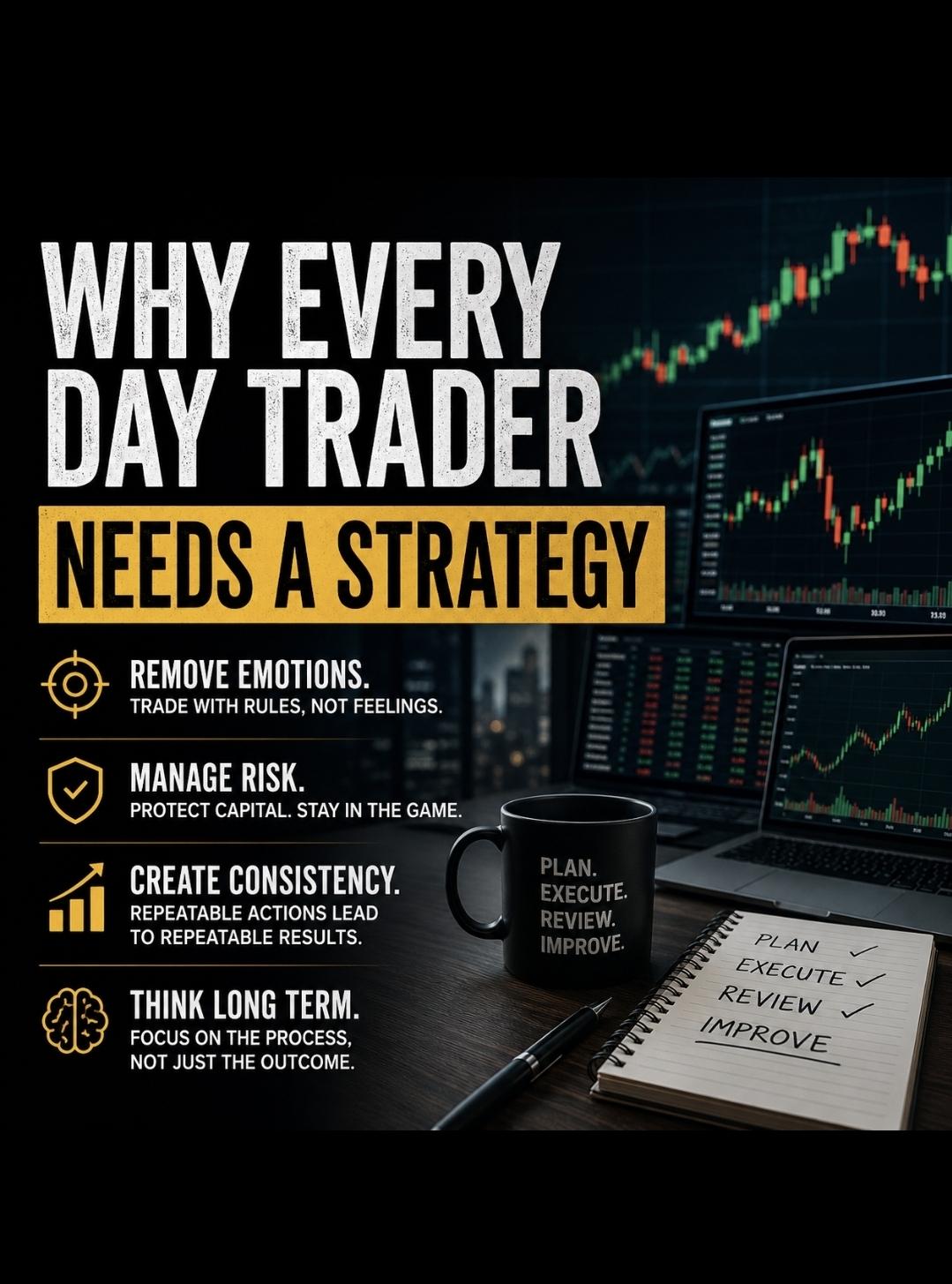
“Hope is not a strategy.” – Anonymous
You need a trading strategy. Otherwise you’re just a gambler. Chasing that big hit. Strategize, learn, build and win with patience and discipline.
The allure of day trading is easy to understand. Financial markets are open every weekday, opportunities seem endless, and modern technology allows almost anyone with an internet connection to participate. Stories of traders turning small accounts into substantial fortunes circulate across social media every day.
Yet for every success story, countless traders quietly lose money, burn out, or abandon the markets altogether.
The difference often comes down to one critical factor: strategy.
A day trader without a strategy is like a pilot flying through a storm without instruments. While they may occasionally reach their destination through luck, eventually uncertainty catches up with them. Consistent profitability requires a repeatable process, not random decision-making.
The Market Doesn’t Care About Your Opinions
One of the first lessons every trader learns is that the market is under no obligation to validate their beliefs.
You may think a stock is undervalued. You may believe a cryptocurrency should rally. You may be convinced that a news event will drive prices higher. None of that matters.
Markets move based on the collective actions of millions of participants, institutions, algorithms, and investors around the world. Successful traders recognize that their opinions are far less important than what the price is actually doing.
A strategy helps remove emotional decision-making and replaces it with objective criteria. Instead of asking, “What do I think will happen?” the trader asks, “Does this setup meet my rules?”
That shift alone can dramatically improve decision quality.
Consistency Creates Results
Many new traders approach the market like a casino. They jump between indicators, chase trending stocks, and constantly search for the next “secret” strategy.
The problem is that consistency becomes impossible when you’re constantly looking for big hits rather than consistent results.
Imagine trying to evaluate a business while changing the business model every week. You would never know what is working and what isn’t. Trading is no different.
A well-defined strategy allows traders to gather meaningful data over time. They can track win rates, average gains, average losses, risk-to-reward ratios, and overall profitability.
Without consistency, improvement becomes nearly impossible because there is nothing measurable to improve.
Risk Management Is Part of the Strategy
Many traders focus exclusively on entries. They spend hours searching for the perfect signal while paying little attention to risk.
In reality, risk management is often more important than finding the perfect trade.
A complete trading strategy should answer several key questions:
- When will I enter a trade?
- When will I exit for a profit?
- When will I exit for a loss?
- How much capital will I risk per trade?
- What market conditions am I willing to trade?
Professional traders understand that losses are inevitable. Their goal is not to eliminate losses but to manage them; A trader who loses 1% on a bad trade can recover relatively quickly. A trader who loses 25% of their account on a single position may spend months trying to recover.
Protecting capital is what allows traders to stay in the game long enough to develop skill. Set boundaries that are comfortable for you. Some people like to take the high-risk, high-reward route- and that’s totally fine, as long as you know that you are comfortable losing whatever you’re willing to risk.
Losses Are Inevitable
Perhaps the hardest lesson for new traders to accept is that losses are not a sign of failure. They’re part of the business. Even the world’s best traders experience losing trades. No strategy produces winners 100% of the time, and any trader who claims otherwise should be viewed with skepticism.
The objective of a trading strategy is not to eliminate losses. The objective is to ensure that winning trades, over time, outweigh losing ones.
Consider any successful business. Restaurants have food waste. Retail stores experience theft and damaged inventory. Manufacturers deal with defects and production costs. These losses are accepted because they are part of generating profit. Trading is no different.
A losing trade that follows your rules is often a better trade than a winning trade that breaks them. The first reinforces discipline and protects long-term consistency. The second encourages dangerous habits that can eventually lead to significant losses. It’s building trader vs gambler habits.
Many traders fail because they take losses personally. Instead of viewing a losing trade as a normal business expense, they see it as a reflection of their intelligence or ability. This mindset often leads to revenge trading, oversized positions, and emotional decision-making. Don’t let the emotions get irrational here. Learn and move on.
Professional traders understand that losses are simply one cost of participating in the market. Their focus remains on executing their strategy, managing risk, and allowing probabilities to play out over a large sample size of trades. The sooner a trader accepts the inevitability of loss, the sooner they can focus on what truly matters: consistency, discipline, and long-term profitability.
Strategy Reduces Emotional Trading
Fear and greed are among the most destructive forces in financial markets.
Fear causes traders to exit winning trades too early. Greed causes them to hold positions too long. Both emotions can lead to impulsive decisions that undermine long-term performance. A strategy creates structure.
When entry rules, exit rules, and risk parameters are defined beforehand, there is less room for emotional interference. The trader simply executes the plan.
This doesn’t eliminate emotions entirely. Every trader experiences them.
However, a solid strategy prevents emotions from becoming the primary decision-maker.
No Strategy Works All the Time
One of the biggest misconceptions among new traders is the belief that there is a perfect system somewhere. There isn’t.
Every strategy experiences periods of strong performance and periods of underperformance. Markets evolve. Volatility changes. Economic conditions shift.
Successful traders understand this reality. Rather than searching endlessly for perfection, they focus on finding an edge that works over a large sample size of trades. They understand that success comes from disciplined execution, continuous learning, and proper risk management.
The goal isn’t to win every trade.
The goal is to make money over time.
The Reality of (Strategic) Trading
Day trading is often portrayed as a fast path to wealth. In reality, it is a skill-based endeavor that requires discipline, patience, and a structured approach.
A strategy provides that structure.
It creates consistency, manages risk, reduces emotional decision-making, and allows traders to evaluate their performance objectively. Most importantly, it transforms trading from gambling into a professional process.
Whether you are trading stocks, options, futures, or cryptocurrencies, developing and following a strategy is not optional—it is essential.
The market will always be uncertain. Your approach to the market shouldn’t be.