“Public policy is not an abstract game—it is the quiet force that shapes the incentives of millions, and in doing so, determines whether a society drifts toward prosperity or decay.”
-Thomas Sowell
Policy Is Not Theory -It’s Trajectory
Policy doesn’t announce itself with thunder. It doesn’t knock on your door and tell you your rent just went up because of a zoning law passed three years ago. It doesn’t explain why your grocery bill climbed, why wages stagnated, or why opportunity seems to shift from one sector to another overnight. But it’s there.
Always.
Policy is the invisible hand behind the visible struggle. The truth, often ignored, is this: policy impact is less about intentions and more about incentives.
Incentives: The Real Language of Policy
People don’t respond to speeches. They respond to incentives.
You can pass a law with the best intentions in the world, but if it rewards inefficiency, punishes productivity, or distorts price signals, the outcome is already written.
Cap prices → shortages emerge
Subsidize risk → recklessness grows
Tax productivity → output declines
Print money → purchasing power erodes
This isn’t ideology. It’s cause and effect. As Thomas Sowell often emphasized, there are no solutions, only trade-offs. Policy doesn’t eliminate problems. It moves them.
The Modern Landscape: Policy in Action
Look around today’s markets and you’ll see policy impact everywhere.
Housing Markets
Zoning restrictions and permitting delays don’t just “organize cities”—they choke supply. The result? Artificial scarcity. Rising prices. Entire generations priced out of ownership.
Energy Markets
Subsidies and restrictions reshape the energy mix—not based purely on efficiency, but on political preference. The consequence? Volatility, dependency, and sometimes fragility.
Financial Markets
Low interest rates and monetary expansion fuel asset inflation. Stocks rise. Real estate booms. But beneath it all, risk builds quietly—waiting for reality to catch up.
Labor Markets
Minimum wage laws, benefits structures, and regulatory burdens don’t just “protect workers.” They also determine who gets hired—and who doesn’t.
Policy doesn’t just participate in the market.
It defines the playing field.
The Illusion of Control
There’s a dangerous assumption baked into modern thinking: that policy can precisely engineer outcomes. It can’t.
Every intervention creates ripple effects—second, third, fourth-order consequences that no committee can fully predict. Fix one problem, create two more. Stabilize one sector, distort another. The more complex the system, the more unpredictable the results. Yet, the confidence in control remains.
Why Policy Impact Matters More Than Ever
We’re entering an era where policy is accelerating:
- Central banks adjusting liquidity in real time
- Governments expanding regulatory reach
- Global tensions influencing trade, energy, and capital flows
The speed of policy change is increasing, so is its impact. If you’re building wealth, running a business, or simply trying to navigate life, understanding policy is no longer optional- it’s survival.
A Free Market Perspective
In a truly free market, policy steps back. Prices communicate truth. Voluntary exchange drives value. Failure teaches faster than regulation ever could. In reality, we operate in a mixed system, where policy and markets are constantly interacting, sometimes cooperating, often clashing.
The goal isn’t to ignore policy. The goal is to see it clearly. To understand where it distorts, and where opportunity emerges because of it.
Follow the Incentives
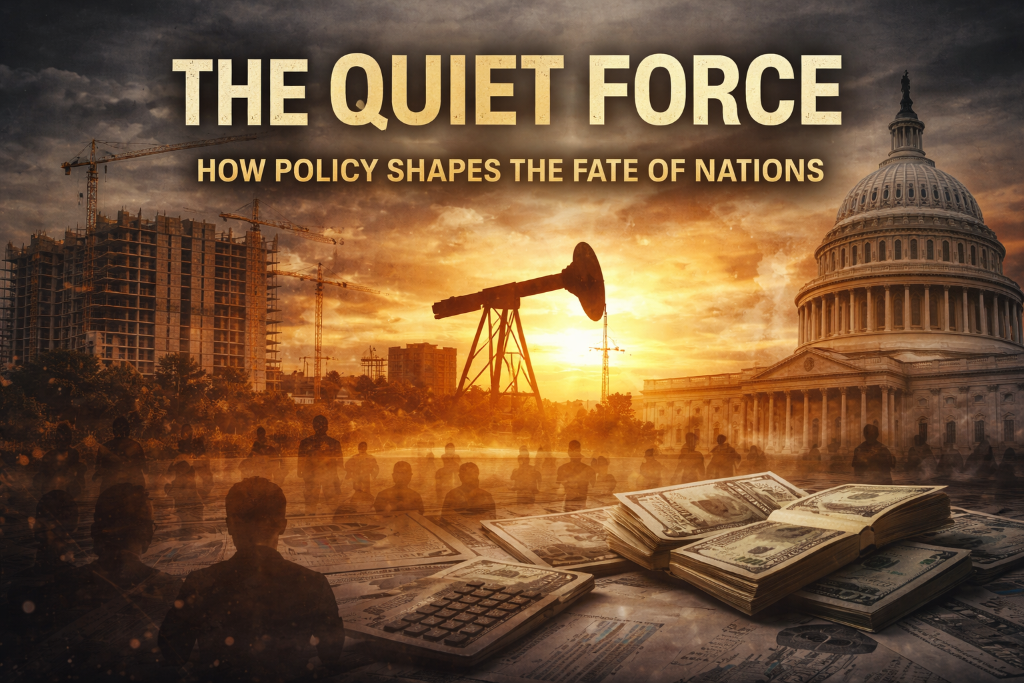
If you want to understand where a society is headed, don’t listen to what policymakers say. Watch what their policies reward. That’s the real signal. That’s the quiet force.
Over time, that force determines everything- from the price of bread to the strength of a nation.