
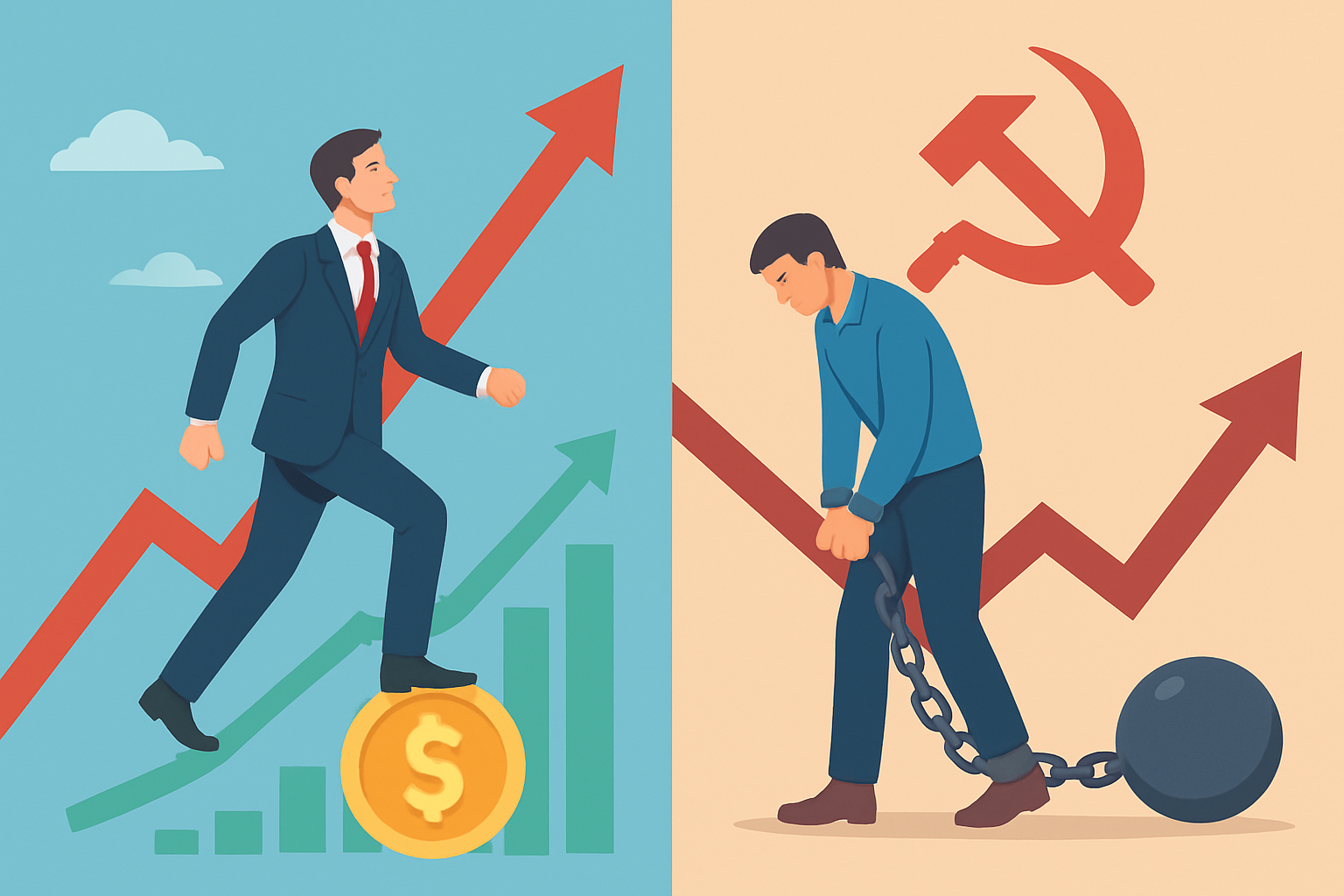
“Socialism is a philosophy of failure, the creed of ignorance, and the gospel of envy, its inherent virtue is the equal sharing of misery.” -Winston Churchill
There’s a funny thing about human nature: we tend to produce more when the reward for producing more actually belongs to us. It’s almost like common sense, except for the fact that governments have been trying to outsmart that truth for centuries. Every time someone comes up with a shiny new version of “planned prosperity,” the math never works. Why? Because prosperity isn’t something you plan- it’s something you create. The free market remains the most reliable way humans have ever discovered to create it.
Let’s talk about why.
Free Markets Align Incentives — Socialism Misaligns Them
In a free market, your effort is tied to your reward. Work more, build more, innovate more, and you often earn more. It’s not perfect, but it is directionally correct. People respond to incentives.
In a socialist economic structure, rewards are divorced from effort. The system pays you because you exist, not because you contribute. When you disconnect effort from return:
- Productivity declines
- Innovation dries up
- Risk-taking disappears
- People stop trying to go above and beyond
It becomes an economy of “good enough,” not “how great can this become?” When the system owns the rewards, the system makes the decisions. Individuals simply become labor units inside someone else’s blueprint. That may produce equality — but it’s equal stagnation.
Free Markets Multiply Solutions
Imagine one central planner trying to solve the needs of 330 million people. Now imagine 330 million people solving their own needs and innovating solutions for others.
Which system wins? The one where millions of minds compete, collaborate, and innovate. Free markets are decentralized problem-solving machines. They adapt. They pivot. They learn.
Socialist economies bottleneck innovation because the decision-making happens at the top, not the ground floor. And the people at the top? They’re guessing. No matter how educated, no bureaucrat knows the needs of your community better than you do.
Free Markets Encourage Risk — Socialism Punishes It
Every major breakthrough in human civilization — from technology to medicine to energy — came from someone willing to take a risk. Risk requires potential reward. If the government takes most of your reward or controls the entire structure of return, risk-taking becomes irrational. Why gamble everything when the payoff is limited?
In free markets:
- Entrepreneurs take risks
- Investors fund them
- Customers validate them
- Workers benefit from the growth
Under socialism, all risks are absorbed by the state, which means they avoid risk altogether. After all, bureaucracies hate uncertainty. They prefer stability, even if that stability is mediocre.
Free Markets Naturally Correct Themselves
Markets swing, shift, adapt, and self-regulate over time because countless participants are constantly adjusting behavior. Bad products fail. Inefficient businesses close. New ideas replace old ones.
Socialist structures don’t self-correct, they entrench. Once the government sets a policy, it tends to stay forever. Failure doesn’t cause change; it causes larger budgets, new committees, and louder speeches about the need for “reform.”
The free market has competition; socialism has committees. Guess which one solves problems faster?
People Thrive When They’re Free
At the end of the day, the free market isn’t just an economic system, it’s an expression of personal liberty. It says:
“You are allowed to create value. You are allowed to exchange value. You are allowed to keep the value you produce.”
Socialist systems say the opposite:
“You can work, but the value belongs to the collective — and the collective is administered by the state.”
Economic freedom is human freedom. When people are allowed to build, innovate, trade, take risks, fail, succeed, and try again, societies flourish.
The evidence speaks for itself:
The most prosperous nations in history were market-driven.
The most stagnant and impoverished were centrally controlled.
Even socialist-leaning countries depend on global capitalism to survive.
Free markets aren’t perfect — but they are optimal. They unleash human creativity, reward productivity, and generate wealth that lifts entire civilizations.
Socialist systems simply reallocate wealth until there’s no wealth left to reallocate.
If you want growth, innovation, prosperity, and opportunity, the equation is simple:
More freedom. Less control.
More markets. Less management.
That’s the formula civilization keeps rediscovering, and the one we shouldn’t ignore